A commercial kitchen floor fails for boring reasons. Grease, hot oil, dropped pans, constant water, and a health inspector who wants to see a surface that cleans up completely.
Chef Roy Choi just gave Orange County a reason to think about this. His Korean barbecue restaurant Best Friend, a hit at Park MGM in Las Vegas, is coming to the OCVIBE district next to Honda Center in Anaheim, according to the Orange County Business Journal.
It is a good moment to look at what actually keeps a restaurant floor legal, safe, and open through a lunch rush.
Why Restaurant Floors Are a Different Problem
A retail floor deals with foot traffic. A kitchen floor deals with everything a kitchen throws at it, all day, every day.
That includes standing water near dish stations, animal fat and cooking oil around the line, cleaning chemicals at close, and thermal shock when boiling water hits a cold slab. Bare or sealed concrete does not hold up to that mix for long.
Southern California health codes also require that floor surfaces in food prep areas be smooth, durable, and easily cleanable. A porous or cracked floor traps grease and bacteria, and that is exactly what an inspector writes up.
What a Kitchen Floor Has to Do
- Resist grease, oil, and food acids without staining or breaking down
- Provide slip resistance even when wet or greasy
- Clean fully with no seams or grout lines holding residue
- Handle hot spills and cold storage without cracking
- Take rolling carts, dropped pans, and constant foot traffic
Where Epoxy and Polyaspartic Fit
A properly built resinous floor solves most of these problems at once. It bonds to the concrete and forms one continuous surface with no grout lines for grease to hide in.
For the kitchen and back of house, a restaurant and foodservice floor system is usually the right call. These are built with a non slip aggregate and coved bases so the floor curves up the wall, which makes washdowns fast and keeps water out of the seams.
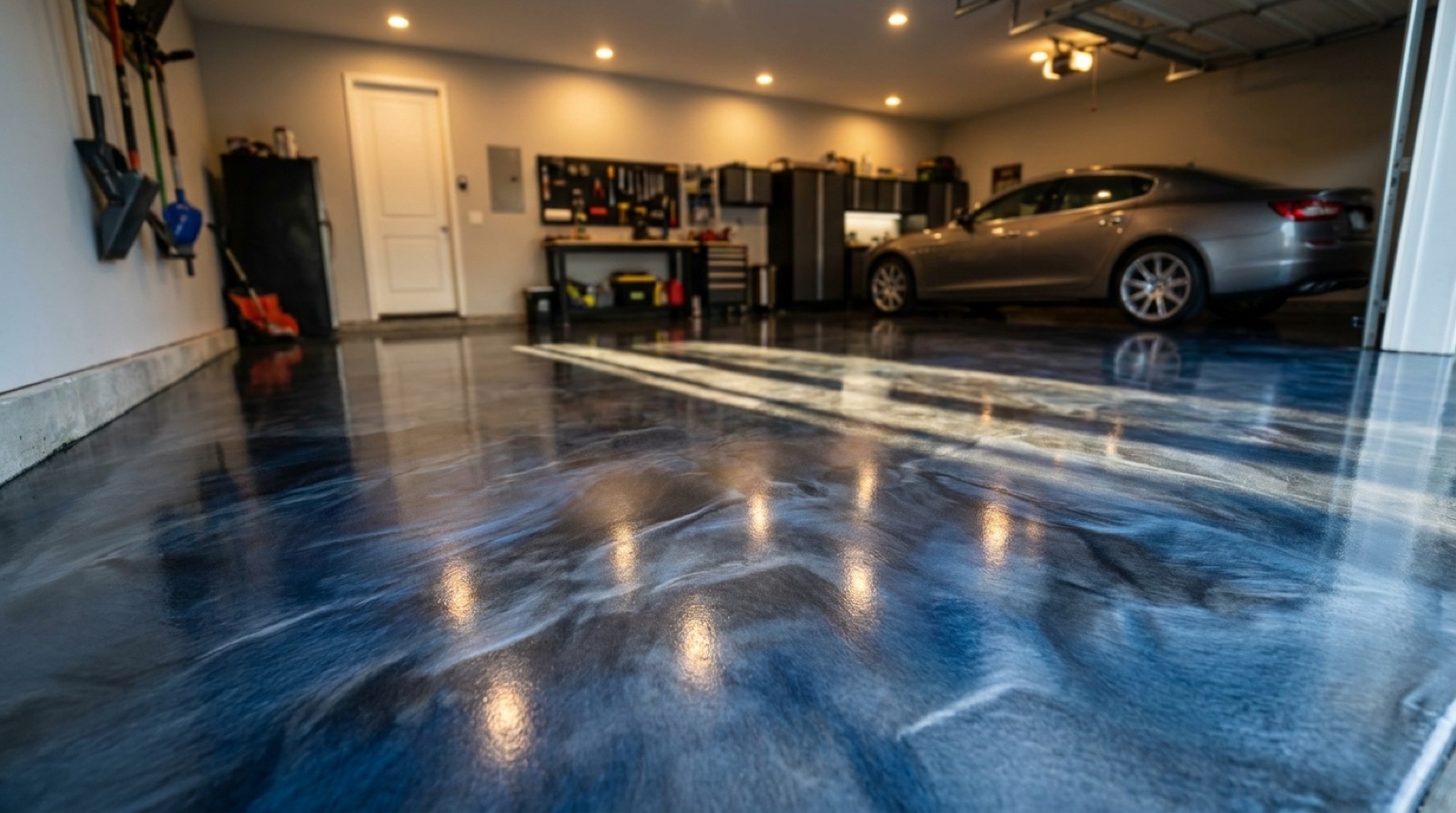
For the front of house, a dining room reads differently. That is where a decorative metallic finish or a stained concrete look earns its place, giving the room a finished surface that still wipes clean.
Epoxy vs Polyaspartic in a Food Setting
| Factor | Epoxy Base | Polyaspartic Topcoat |
|---|---|---|
| Cure speed | Slower, needs downtime | Fast, often back open within a day |
| Chemical resistance | Strong against grease and acids | Strong, adds UV and abrasion resistance |
| Best role | Build thickness and bond | Seal, protect, add grip |
Most durable restaurant floors use both. An epoxy build coat for strength, then a polyaspartic top layer for fast return to service and long term wear.
That speed matters for an operator. A floor that reopens in a day instead of a week is real money for a working restaurant.
It Is Not Just New Restaurants
OCVIBE is a large project, but most Orange County kitchens do not get built from scratch. They get renovated, re tenanted, or repaired between owners.
An old slab with cracks and pitting can still take a coating, but only after the concrete is sound. That often means resurfacing and crack repair first, so the new floor bonds instead of peeling.
The same logic applies well beyond food service. Warehouses, showrooms, and shops across Irvine, Santa Ana, and Anaheim rely on the same core systems.
Related Commercial Systems
- Commercial epoxy flooring for retail, offices, and mixed use spaces
- Industrial and warehouse coatings for forklift traffic and heavy loads
- Showroom and auto flooring for dealerships and service bays
What This Means If You Run a Kitchen in OC
If you operate or plan a restaurant anywhere in Orange County, the floor is not a finish detail. It is equipment.
It affects your health score, your slip and fall risk, and how fast your staff can close and clean at night. A cheap floor that fails in a year costs more than a proper one that lasts.
Choi opening a marquee concept in Anaheim is a reminder that OC's food scene keeps growing. Every one of those kitchens sits on a floor that has to earn its keep.
If you want a straight answer on the right system for your space, get in touch for a quote and we will walk your slab with you.