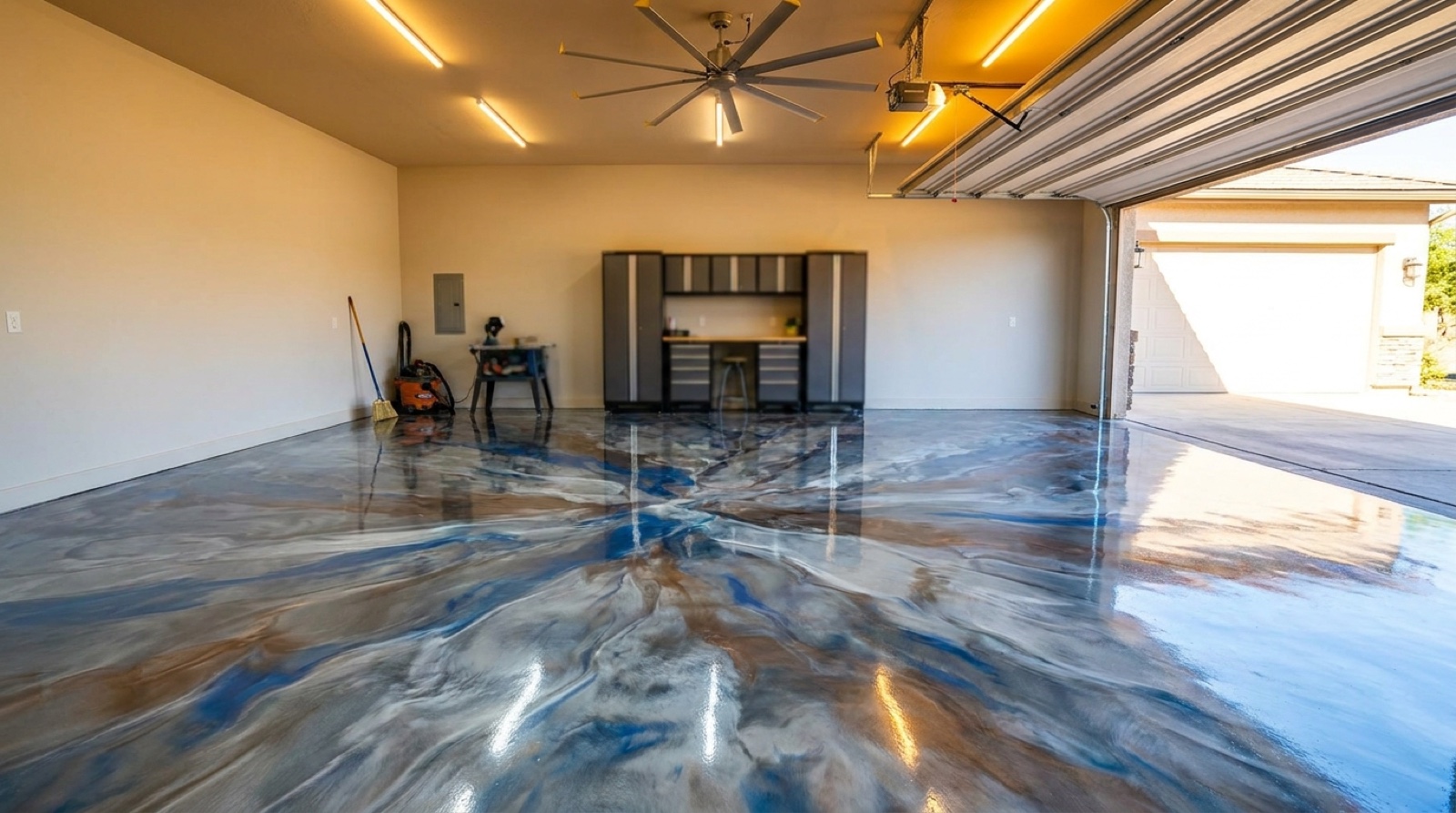
Epoxy is a rigid, thick-building base coat that bonds hard to concrete. Polyaspartic is a fast-curing, flexible, UV-stable topcoat.
They are not competitors so much as different jobs. The strongest garage floors use both: epoxy for adhesion and body, polyaspartic for the wear surface.
If a contractor pushes one system as universally better, that usually says more about what they stock than what your slab needs.
The Chemistry, Without the Sales Pitch
Epoxy is a two-part resin and hardener that cross-links into a hard, dense plastic. It builds thickness well, fills minor surface imperfections, and grips prepared concrete tightly.
Polyaspartic is a subset of polyurea, an aliphatic ester that cures through a controlled reaction with an amine. Aliphatic is the important word, because it is what makes the coating resistant to ultraviolet breakdown.
The practical result is a difference in personality. Epoxy is stiff and thick. Polyaspartic is thinner per coat, more elastic, and far more tolerant of sunlight and temperature swings.
Cure Time Is the Biggest Day to Day Difference
Standard epoxy needs roughly 12 to 24 hours between coats and several days before you park a vehicle on it. A full garage floor coating project built purely on epoxy typically keeps you out of the space for three to five days.
Polyaspartic cures in a fraction of that. Many polyaspartic systems are walk-ready in a few hours and rated for vehicle traffic in about 24 hours.
That speed cuts both ways. The working window can be as short as 20 to 30 minutes, which means an inexperienced crew can ruin a batch before it reaches the floor.
What Fast Cure Costs You
- Almost no time to correct roller marks or lap lines
- Higher material cost per gallon than standard epoxy
- Sensitivity to humidity, which matters in coastal Orange County more than inland
- Little forgiveness for poor concrete prep, since the coating goes down fast and locks in errors
UV Stability and the Yellowing Problem
Most epoxies are aromatic, and aromatic resins break down under ultraviolet light. The chemical bonds absorb UV energy and degrade, which shows up as ambering, chalking, and a dull surface.
In a closed garage this rarely matters. Under a Southern California sun it matters a great deal.
Anywhere sunlight reaches the slab, including a covered patio or outdoor living area, an exposed driveway surface, or a pool deck, polyaspartic is the correct top layer. Epoxy alone will fade there within a couple of seasons.
Even in a garage, an open door for several hours a day puts real UV on the first several feet of slab. That strip is usually where a pure epoxy floor starts showing its age first.
Hot Tire Pickup
Hot tire pickup is the failure most Orange County homeowners actually experience. A tire heats up on the freeway, the rubber softens, and when the car parks the tire adheres to the coating and lifts it away as it cools and contracts.
Rigid epoxy is more vulnerable because it cannot flex with the thermal cycling. Polyaspartic has more elongation and better heat tolerance, so it releases the tire instead of tearing.
That said, most hot tire failures trace back to bad concrete prep rather than the resin. If the coating was rolled onto sealed or unground concrete, it will lift no matter which product went down.
Side by Side Comparison
| Factor | Epoxy | Polyaspartic |
|---|---|---|
| Cure to vehicle traffic | 3 to 5 days | About 24 hours |
| UV stability | Poor, ambers over time | Excellent, stays clear |
| Flexibility | Rigid | Elastic |
| Hot tire resistance | Moderate | High |
| Build thickness | High per coat | Thin per coat |
| Working window | 1 to 2 hours | 20 to 30 minutes |
| Material cost | Lower | Higher |
| Concrete bonding | Excellent | Good |
Why the Hybrid System Wins
Read that table again and the answer becomes obvious. Each product covers the other one's weakness.
A hybrid build usually runs three layers. Epoxy goes down first as a base coat for adhesion and thickness, then decorative vinyl flake or chip broadcast sets into it, and a polyaspartic topcoat seals everything with UV protection and abrasion resistance.
You get the bonding strength of epoxy, the durability and clarity of polyaspartic, and a return to service in roughly one to two days instead of a week.
When a Single System Makes Sense
- Epoxy only: interior spaces with no sunlight and no schedule pressure, such as a windowless storage room or back of house area
- Polyaspartic only: thin-film jobs over sound concrete where speed matters most, like an occupied commercial space that cannot close for a week
- Neither: slabs with active moisture intrusion or structural cracking, which need concrete repair before any coating goes down
What This Means for an Orange County Slab
Local conditions push the decision. Coastal humidity from Huntington Beach through Newport Beach affects cure behavior, and inland heat in Anaheim and Santa Ana drives the hot tire problem harder.
Homes across Irvine and the rest of OC also have the sun exposure that makes a UV-stable topcoat worth paying for. A pure epoxy floor in a south-facing garage here is a floor with a countdown on it.
The real question is not which resin is better. It is whether your slab is prepped correctly, which layer belongs where, and what the space actually endures. Get in touch for a quote and we will look at your concrete before recommending a system.