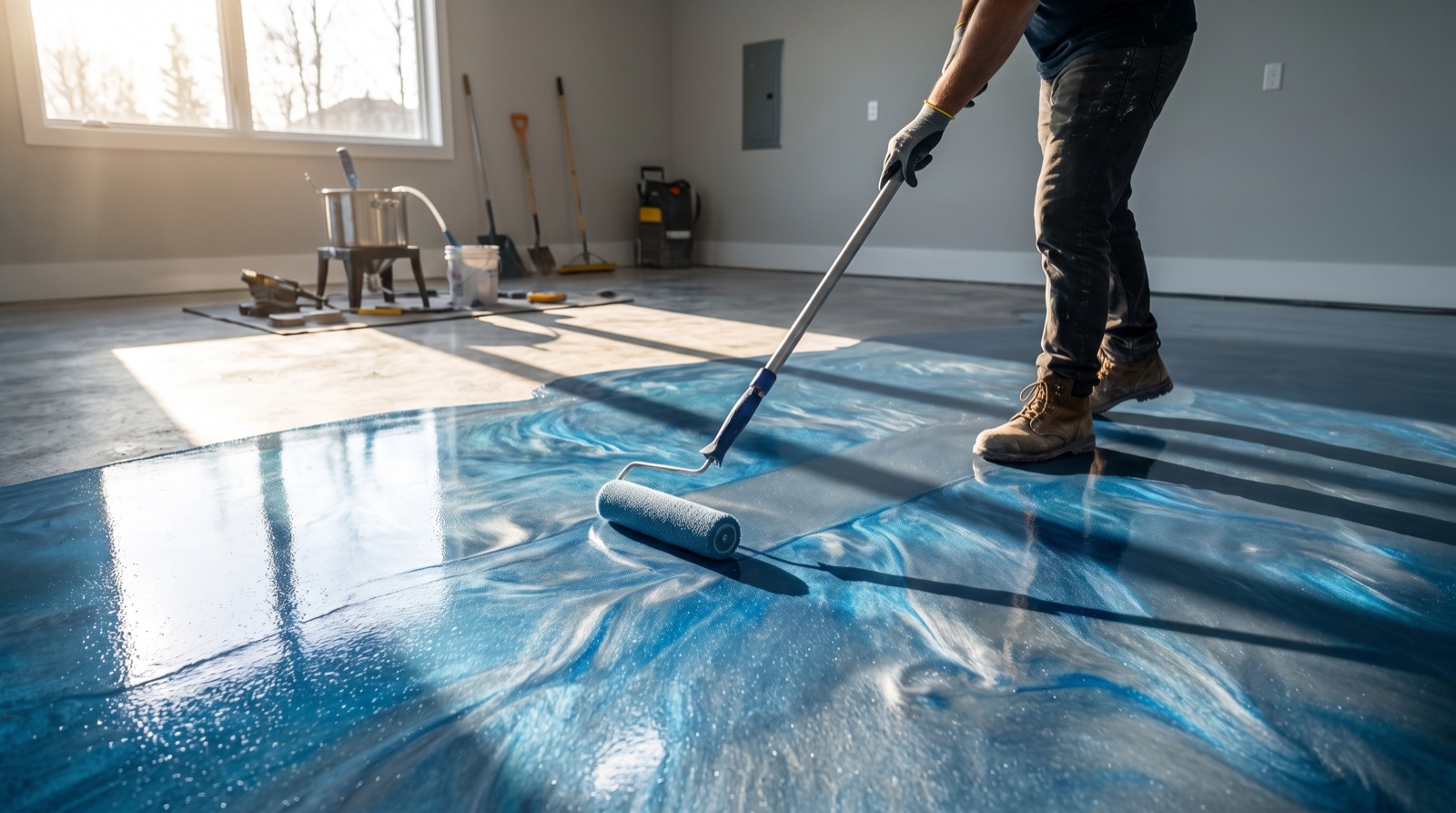
A standard two car garage takes three days of on site work. You can walk on the floor 24 hours after the final coat and park a vehicle on it 72 hours after that.
That is the honest answer for most residential jobs. Larger floors, heavier repairs, and different coating chemistries move the number in both directions.
The Standard Three Day Schedule
Almost every professional epoxy installation follows the same sequence. The days are not interchangeable and skipping ahead is the single most common reason coatings fail early.
Day 1: Preparation
This is the longest and most important day. The crew diamond grinds or shot blasts the slab to open the concrete pores so the coating can mechanically bond.
Oil spots get degreased, cracks and spalls get routed out and filled, and expansion joints are addressed. On an older Orange County slab with 20 years of drips, prep alone can stretch into a second day.
Day 2: Base Coat
The primer and pigmented base coat go down. If you chose a decorative system, this is when the vinyl flakes get broadcast into the wet resin.
The floor then cures overnight. Nobody walks on it.
Day 3: Top Coat
Excess flake is scraped and vacuumed, then the clear top coat is rolled on. This is the layer that carries the gloss, the UV stability, and the abrasion resistance.
From here the clock is chemistry, not labor.
Cure Times: Walk, Furniture, Drive
Installation time and cure time are two different things. The crew leaves on day three, but the floor is not finished hardening.
| Activity | Wait After Final Coat |
|---|---|
| Light foot traffic | 24 hours |
| Shelving, tool chests, gym equipment | 48 hours |
| Vehicle tires | 72 hours |
| Full chemical resistance | 7 days |
The 72 hour rule for vehicles matters more than people expect. Hot tires from a car that just came off the 405 can pull a soft coating right off the slab, a failure known as hot tire pickup.
Timelines by Project Type
Square footage is only part of the equation. Slab condition and system type usually drive the schedule more than size does.
| Project | On Site Days | Return to Use |
|---|---|---|
| Single car garage | 2 to 3 | 72 hours |
| Two to three car garage | 3 | 72 hours |
| Patio or pool deck | 2 to 3 | 48 to 72 hours |
| Driveway | 3 to 4 | 72 hours |
| Retail or office (under 3,000 sq ft) | 3 to 5 | 72 hours |
| Warehouse (10,000 sq ft plus) | 5 to 10, often phased | 72 hours per zone |
Garages
A coated garage floor is the most predictable job on the list. Three days start to finish, with the only real variable being how much crack repair the slab needs.
Adding a decorative flake broadcast does not extend the schedule. The flake goes into the wet base coat on day two.
Decorative and Specialty Systems
Metallic floors take longer. A poured metallic finish needs extra cure time between the artistic layer and the top coat, which usually pushes the job to four days.
Polished concrete works differently. There is no cure window at all, so a mechanically polished slab is walkable the same day the crew finishes.
Commercial and Industrial
Large floors get sectioned. A commercial installation is typically phased so half the space stays operational while the other half cures.
Night and weekend scheduling is standard for restaurants and retail across Irvine, Anaheim, and Santa Ana. The crew works after close and the space opens on schedule.
The One Day Option
Polyaspartic coatings cure in roughly one hour per coat instead of overnight. That collapses the entire three day schedule into a single day.
Grind in the morning, base coat before lunch, top coat in the afternoon. You walk on it that evening and park on it the next day.
The trade offs are cost and working time. Polyaspartic material runs higher per square foot and the fast set leaves installers a very short window, which is why one day polyaspartic systems are not a DIY product.
The upside beyond speed is UV stability. Polyaspartic does not amber in direct sun, which is why it is the default for exposed driveway surfaces and outdoor patios across coastal Orange County.
What Actually Delays a Job
Most schedule overruns trace back to the slab, not the crew.
- Moisture in the concrete. A slab reading high on a calcium chloride test needs a vapor barrier primer, adding a day.
- Structural cracking. Deep cracks and spalled edges require patching and resurfacing that must cure before coating.
- Existing coatings. Old sealer or failed DIY epoxy has to come off entirely, which can double prep time.
- Marine humidity. Coastal air in Huntington Beach and Newport Beach slows epoxy cure. Crews adjust catalyst ratios, but damp mornings still push start times back.
- A full garage. The space must be completely empty before day one. Clearing it yourself keeps the schedule intact.
How to Plan Your Week
For a garage, block out four days. Three for the work and one buffer before you move vehicles back in.
Mild California weather means installations run year round here, with no seasonal shutdown. Spring and early fall bring the most stable humidity, which makes scheduling easiest.
If you need the floor back fast, say so upfront. Tell us your deadline when you request a quote and we will tell you honestly whether epoxy or a one day polyaspartic build is the right fit.