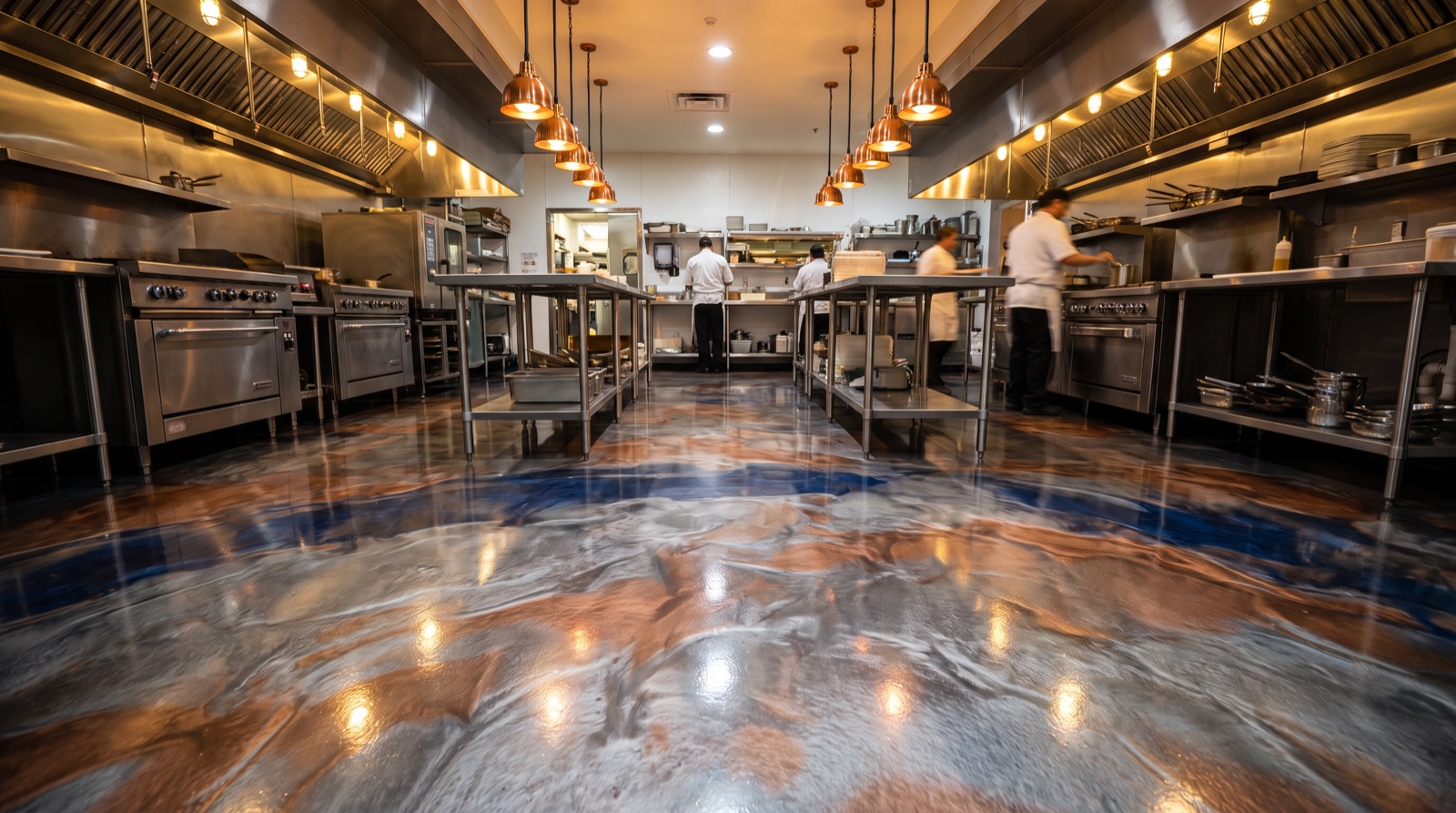
A restaurant kitchen floor in Orange County has to satisfy two audiences: the LA County / OC Health Department (which inspects for seamless cleanability) and your slip-and-fall insurance carrier (which prices on documented coefficient of friction). Polyaspartic-quartz systems with coved bases are the standard answer for both.
What Health Inspectors Look For
OC Health Department inspectors evaluate kitchen floors against a few criteria pulled from the FDA Food Code and California Retail Food Code:
- Seamless surface — no grout lines, no joints where bacteria can hide
- Coved base — 4-6 inch radius coving where the floor meets the wall, eliminating the floor/wall seam
- Smooth, durable, non-absorbent — meets and exceeds with polyaspartic
- Easily cleanable — no porous surfaces, no joints, no sealed grout
Quarry tile (the legacy standard) fails on the seamless test as soon as the grout starts to fail — which it does within 5-10 years in any commercial kitchen.
The Polyaspartic-Quartz System
The industry-standard kitchen floor for the last 15 years:
- Diamond grind to ICRI CSP 3 (industrial profile)
- Build a 4-6 inch coved base up the wall using a polymer cove material
- Polyaspartic-quartz pigmented base coat at 12-16 mils
- Quartz broadcast to refusal across floor and cove
- Two polyaspartic top coats with hot-water and grease resistance
The result is a single seamless floor-to-base surface with no joints, USDA-compatible chemistry, aggressive anti-slip texture, and 15+ year lifespan.
Slip Resistance
ADA's wet dynamic coefficient of friction (DCOF) requirement is 0.42. Quartz-broadcast polyaspartic kitchens measure consistently above 0.65 wet, well over the threshold. Insurance carriers love documented DCOF measurements — bring the spec sheet to your renewal and watch your premium drop.
Chemical & Heat Resistance
Commercial kitchens see:
- Hot grease at 350°F+ from fryers
- Steam and hot water from dishwashers
- Acidic juices from food prep (citrus, tomatoes, vinegar)
- Aggressive cleaners (degreasers, sanitizers, bleach)
Polyaspartic-quartz handles all of it. Heat deflection above 200°F means hot grease drops don't soften the surface. Chemical resistance covers all common kitchen cleaners. Steam doesn't degrade the chemistry.
Scheduling Around Service
OC kitchens can't shut down for a 3-day install. We schedule around service:
- 48-hour weekend turnover — Friday close to Monday open. Most common for full-service restaurants.
- Overnight zonal install — coat one section per night. Used for 24-hour kitchens.
- Week-long zonal install — for larger kitchens, install in 4-6 zones over a single week, never closing.
We bring our own portable lighting, HEPA dust capture, and odor management. Polyaspartic is low-VOC and odor-light enough that food prep can resume 24 hours after the final coat.
Trench & Floor Drains
Kitchens have floor drains and often trench drains for line cleanup. We coat right into the drain, sealing the concrete inside the drain throat so water and grease can't penetrate the substrate. Drain caps are removed, cleaned, and reinstalled.
Cost
OC kitchen floors typically run $11-$18 per square foot installed including coved base and drain coating. A 600 sq ft kitchen runs $6,600-$10,800. Off-hours scheduling adds 15-25% but eliminates lost revenue.
Common Failure Modes (and Why They Don't Happen Here)
Failed kitchen floors we get called to replace:
- Quarry tile with failing grout — caused by 10+ years of grease, hot water, and traffic. Solution: full tear-out, polyaspartic-quartz replacement.
- Failed coatings missing the cove — bacteria sets up in the floor/wall seam. Inspector will write you up. Solution: rebuild cove.
- Smooth-finish epoxy floors — slippery when wet, fail ADA. Solution: re-coat with quartz broadcast.
- Coatings without USDA-compatible chemistry — fail health inspection on chemical migration. Solution: full removal and replacement.
Brewery, Distillery, and Food Processing
Same chemistry, different additives. Breweries need lactic-acid resistance (beer wort eats standard polyaspartic), so we use a novolac-modified system. Distilleries need solvent resistance for ethanol. Food processors often need ESD-grade flooring around electronic equipment. All of these are extensions of the polyaspartic-quartz baseline.
Get a Free OC Epoxy Quote
Call (949) 744-6229 or use the form below for a free written quote with mandatory moisture testing and lifetime warranty.